
How a patented hydraulic system allows a compact zero-turn platform to perform precision grading, renovation, and finish work typically associated with much heavier equipment.
When people first see the ABI Force Z-23 working a ball field, warning track, or landscape site, the reaction is usually the same: how is a machine this size producing results that normally require a skid steer or tractor?
The answer is RVF technology.
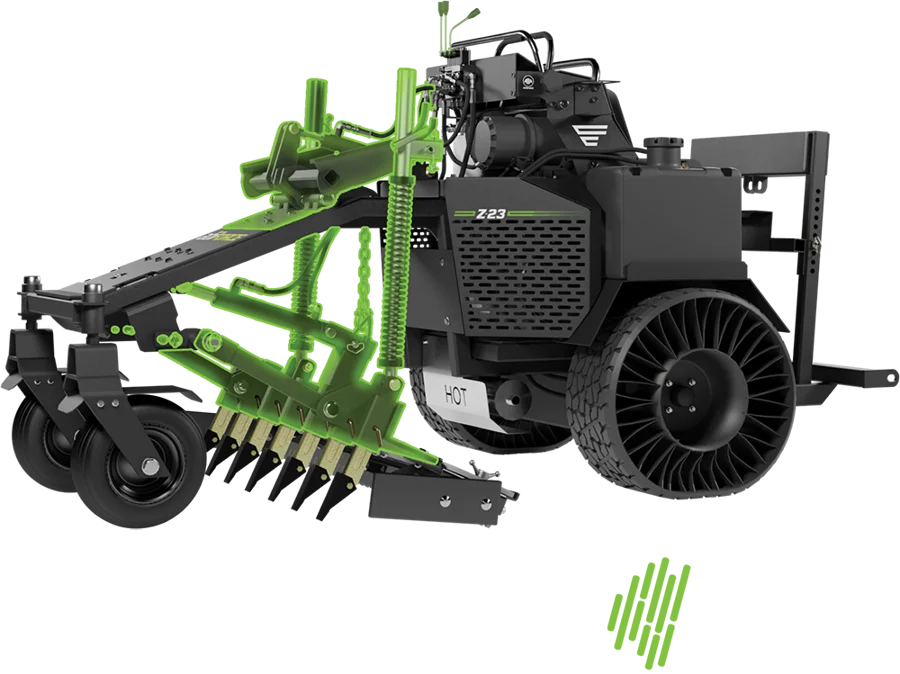
RVF stands for Responsive Variable Force, and it is the hydraulic system that fundamentally defines how the Force operates. Instead of relying on machine weight alone to engage the ground, the system actively applies controlled hydraulic force directly to mid-mount attachments. That distinction is what enables precision grading, surface renovation, and finish work at a professional level from a compact zero-turn platform.
RVF technology is a mid-mounted hydraulic control system integrated into the underside of the ABI Force. It manages ground-engaging attachments through three coordinated functions:
These functions operate hydraulically and continuously while the machine is in motion. The operator is not manually “forcing” the attachment into the ground with machine weight or repeated lifting and dropping. Instead, the system actively controls how the attachment interacts with the surface in real time.
The result is a controlled, repeatable grading process that does not depend on operator strength, machine mass, or constant mechanical repositioning.
At a mechanical level, RVF replaces the traditional reliance on static weight with dynamically applied hydraulic force at the attachment point. That shift is what allows a relatively lightweight machine to behave like a much heavier platform when engaged with soil.
Traditional grading equipment has a limitation: ground engagement force is tied directly to machine weight and traction. If you want deeper cut, better compaction control, or more consistent leveling, you generally need a heavier machine.
That creates two problems:
RVF solves this by decoupling ground engagement force from machine weight.
Instead of relying on mass, the system uses hydraulic pressure to generate downward force at the attachment. That allows the Force to remain:
In practical terms, it is a force multiplication system applied exactly where the work happens: at the soil interface.
Lift controls vertical positioning of mid-mount attachments.
It allows the operator to:
Lift is not the performance feature of RVF, but it is what keeps workflow continuous. On multi-field complexes or large job sites, this reduces downtime between work segments.
This is the defining capability of RVF technology.
Instead of relying on machine weight, the system applies adjustable hydraulic force downward into the attachment. The operator can modulate pressure depending on task requirements:
This control is continuous and adjustable during operation. There is no need to stop, reset, or mechanically change ballast.
The engineering significance is simple: ground engagement force becomes a controllable parameter rather than a fixed constraint.
Pitch determines the angle of attachment contact with the ground.
Pitch adjustment allows the operator to tune how the attachment interacts with surface material without changing tools or stopping the machine.
This is especially important in variable conditions like infields or mixed soil landscapes where surface density changes across short distances.
RVF is not just a mechanical improvement; it changes how the machine is used operationally.
Work that traditionally required a skid steer or tractor can be completed with a compact platform due to controlled hydraulic force at the attachment.
The zero-turn footprint combined with RVF-controlled mid-mount attachments allows operation in areas like dugouts, field edges, and constrained landscape zones.
Because downward force and attachment behavior are hydraulically controlled, the machine reduces dependency on fine manual grading skill alone. The system stabilizes outcomes across different operators.
Operators can transition from aggressive material movement to finish grading without changing machines or attachments.
RVF technology is most visible in three work categories:
It enables controlled infield renovation, surface leveling, and finish grooming where drainage accuracy and surface consistency matter.
It allows soil preparation, grading, and finish work in tight residential or commercial spaces where larger equipment cannot operate.
It supports controlled soil loosening and redistribution without overworking or destabilizing the surface structure.
In all three cases, the key advantage is consistency under variable conditions.
RVF technology is not an accessory system; it is the core functional mechanism that defines how the ABI Force Z-23 operates.
By shifting ground engagement from machine weight to controlled hydraulic force at the attachment, it enables:
In practical terms, it is what allows a compact zero-turn platform to behave like a much larger grading system without inheriting the logistical limitations of heavy equipment.
RVF stands for Responsive Variable Force. It refers to the hydraulic system that controls mid-mount attachments through lift, variable downward pressure, and pitch adjustment.
It applies hydraulic downward force directly to the attachment instead of relying on machine weight. This allows the attachment to engage the ground with force comparable to heavier machines while keeping the platform compact and transportable.
Not entirely. It replaces many tasks that would normally require heavier equipment in small to mid-scale applications, but large-scale earthmoving or high-volume excavation still requires traditional machinery.
Pitch changes the angle of contact between attachment and soil. Forward pitch increases cutting and material movement, while rear pitch reduces aggression and improves finish quality. This allows on-the-fly tuning without stopping work.
Yes. The combination of zero-turn maneuverability and mid-mount hydraulic control allows operation in areas where skid steers and tractors are limited or inefficient, especially around edges, structures, and narrow field zones.